




Comparative Analysis of Primary Systems Across Countries: Mechanisms, Typologies, and Tradeoffs
What Is a Primary System? Definitions and Scope
A primary system is a formal or semi-formal procedure through which a political party selects either its candidates for public office or its leadership — before the general election takes place. The distinction matters: candidate nomination for legislative seats and leadership selection contests operate under different institutional logics, even when both are loosely called "primaries."
General elections determine which party or coalition governs. Primaries determine who represents a party within that contest. Internal party appointments — where a committee or caucus simply designates a nominee without any broader vote — sit at the opposite end of the spectrum from fully open primaries. A working definition for comparative purposes should therefore specify three elements: who votes (the selectorate), who may stand, and who administers the process.
The scope of comparative primary research has expanded considerably since the 1990s. Early scholarship focused almost exclusively on the United States, where direct primaries have been legally embedded in state electoral codes since the early twentieth century. Comparative work now encompasses parliamentary democracies, multi-party systems, and hybrid regimes, making it necessary to have conceptual tools that travel across cases rather than ones calibrated to a single institutional context.
Typologies for Classifying Primary Systems
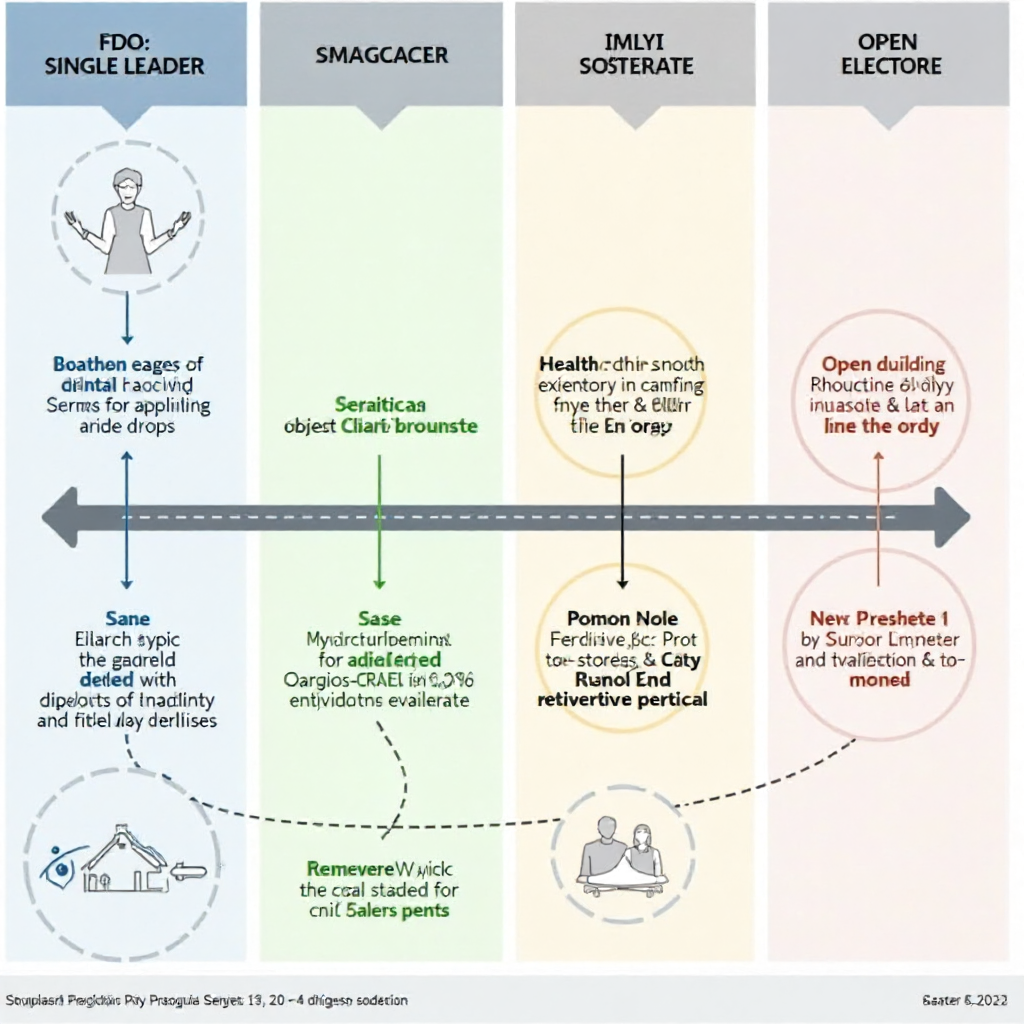
The most widely used framework in academic literature is the Rahat and Hazan selectorate continuum, which organizes primary systems along a single dimension: the inclusiveness of the body entitled to participate in selection. At one pole sits the single leader — one individual makes the decision alone. At the other pole sits the entire national electorate, open to any registered voter regardless of party affiliation.
Between these poles, Rahat and Hazan identify intermediate categories: party agencies (central committees, national executives), party members, and registered party supporters. The framework, developed in their foundational 2001 article in Party Politics and elaborated in subsequent work, is useful precisely because it is institution-neutral — it applies equally to presidential and parliamentary contexts.
Gallagher and Marsh's earlier edited volume Candidate Selection in Comparative Perspective (1988) laid the groundwork by documenting the diversity of national practices and resisting any single organizing typology. Where Gallagher and Marsh emphasized descriptive breadth, Rahat and Hazan offered analytical parsimony. For researchers designing a comparative study, combining both approaches is productive: use the selectorate continuum as the primary variable, and draw on the country-level institutional detail that Gallagher and Marsh's tradition supplies.
A secondary typological axis concerns candidate-centered versus party-centered systems. In candidate-centered contexts, individual politicians build personal followings and finances relatively independently of party structures. In party-centered contexts, the organization controls access to the ballot in ways that constrain individual ambition. This axis is analytically distinct from selectorate inclusiveness — a system can have a wide electorate but still maintain strong organizational gatekeeping at the eligibility stage.
Voter Eligibility Rules: Open, Closed, and Semi-Open Models
Voter eligibility — the question of who may cast a ballot in a primary — is the dimension most familiar to a general audience, but it conceals significant variation in practice. Closed primaries restrict participation to registered party members. Open primaries allow any registered voter to participate, regardless of party registration. Semi-open or semi-closed models occupy the middle ground, typically permitting independents to participate while excluding members registered with a rival party.
Same-day registration variants complicate this typology. Several US states allow voters to register or change party affiliation on the day of the primary itself, which functionally approximates an open primary even when the formal rules describe a closed model. This gap between formal rules and effective inclusiveness is a recurring challenge in comparative coding.
Registered-party-member models — common in European parliamentary democracies — tie participation to a meaningful prior act of affiliation. Membership typically involves paying dues and adhering to party statutes. This produces a selectorate that is smaller and more ideologically committed than the general electorate, which has direct implications for the kinds of candidates who emerge.
The tradeoff here is genuine: broader participation increases democratic legitimacy and public engagement, but it also exposes the selection process to voters whose primary loyalty is not to the party. Concerns about raiding — strategic cross-party voting — are more prevalent in academic debate than in empirical evidence, but they remain a live consideration in institutional design.
Candidate Eligibility and Party Gatekeeping
Party gatekeeping refers to the degree of central organizational control over who may stand as a candidate, independent of voter eligibility rules. Even in highly inclusive primary systems, parties frequently impose eligibility thresholds — signature requirements, loyalty pledges, approval by a national committee, or mandatory candidacy fees.
Self-nomination with minimal barriers characterizes the most open end of the gatekeeping spectrum. At the other end, centralized vetting by a national executive can effectively pre-select a shortlist before any primary vote occurs. The United Kingdom's Conservative Party, for instance, has historically used a parliamentary party ballot to reduce the field before presenting two finalists to the broader membership — a design that preserves elite influence at an early stage while extending participatory legitimacy to members at the final stage.
Gatekeeping affects the ideological range of the candidate pool in predictable ways. Tighter central control tends to produce more ideologically homogeneous slates, since candidates who deviate significantly from party orthodoxy are filtered out before reaching voters. Looser gatekeeping widens the range but may generate coordination problems when the field becomes crowded.
The interaction between voter eligibility and candidate eligibility is underexplored in the comparative literature. A system that is inclusive on the voting side but restrictive on the candidacy side produces a different political dynamic than one that is open on both dimensions — yet many typologies treat these as a single continuum rather than two intersecting variables.
Country Cases in Comparative Perspective
Examining specific cases helps anchor typological distinctions in real institutional practice. The five cases below are chosen not because they are representative of all democracies, but because they illustrate the range of the selectorate continuum effectively.
United States state-level primaries sit at the inclusive end. Most states use either open or semi-closed models for congressional and gubernatorial races, administered by state government rather than by parties themselves. This externalization of the selection process to public law is historically unusual in comparative perspective and produces a distinctly candidate-centered dynamic, since party organizations have limited formal authority over who runs under their label.
United Kingdom leadership contests illustrate the party-member model. Both the Conservative Party and the Labour Party have used variants of a two-stage process: parliamentary colleagues reduce the field, then members vote on the finalists. Labour's 2015-2020 rules expanded eligibility further to registered supporters paying a nominal fee, creating a temporarily enlarged selectorate that shifted the party's leadership selection outcome in ways that generated considerable academic interest.
France provides a case of semi-institutionalized open primaries. The Socialist Party's 2011 presidential primary and the center-right's 2016 equivalent both allowed any citizen to participate on payment of a small fee and signature of a values statement. These were party-organized but publicly accessible — a hybrid that does not fit neatly into standard typologies.
In Israel, major parties have historically used internal party primaries for list ranking, where registered party members vote to determine candidate order on closed proportional representation lists. The interaction between primary outcomes and list-based electoral rules creates incentives that differ substantially from single-member district contexts.
Canada's federal leadership conventions historically relied on delegate-based selection — representatives chosen at the local level, then sent to a national convention to vote. Modern Canadian parties have moved toward one-member-one-vote systems or weighted hybrid models, making leadership selection more direct while retaining some regional weighting to balance territorial representation.
Consequences: Party Cohesion, Representation, and Polarization
Comparative research consistently finds that primary design has measurable downstream effects on legislative behavior, candidate characteristics, and ideological distribution — though the direction and magnitude of these effects depends heavily on the broader electoral and institutional context.
The relationship between selectorate inclusiveness and party cohesion is the most studied. The theoretical expectation is straightforward: candidates who win election through a broad, diverse electorate are less beholden to the party organization and more inclined to deviate from the legislative party line. Evidence from the US Congress generally supports this, though causation is difficult to establish cleanly given confounding factors like district ideology.
On descriptive representation — the demographic composition of the candidate pool — the findings are more mixed. Some studies find that closed primaries with active party gatekeeping produce more diverse candidate slates, because organizations can affirmatively recruit underrepresented groups. Others find that expanded participation increases representation by reducing the gatekeepers' ability to favor established networks. The outcome depends substantially on whether the party organization itself is committed to diversity as a criterion.
Concerns about ideological polarization driven by primaries have been prominent in the US context, where primary electorates are documented to be more extreme than general electorates. In proportional systems with multi-party competition, the mechanism operates differently — parties compete for ideologically defined niches, so the polarization dynamic is mediated by the structure of the party system rather than by primary rules alone.
Methodological Considerations for Comparative Research
Designing a comparative study of primary systems requires attention to three recurring methodological challenges: case selection, operationalization, and data availability.
Case selection is particularly consequential. The universe of cases is large in principle but uneven in documentation. A most-similar systems design comparing countries with comparable party systems but different primary rules is analytically attractive but practically difficult, because primary rules tend to co-vary with other institutional features. A most-different design sacrifices control for range. Most published comparative work uses a small-N structured comparison with explicit attention to scope conditions.
Operationalizing selectorate inclusiveness as a measurable variable is less straightforward than the Rahat-Hazan continuum implies. Formal rules and effective participation diverge — a party with open primary rules but very low turnout may produce a de facto selectorate as narrow as a closed-member model. Researchers should distinguish between institutional access (who is formally eligible) and actual composition (who participates), and ideally measure both.
Data availability remains uneven. The US benefits from decades of primary election returns archived at the state level and synthesized in datasets like DIME and the MIT Election Lab. European party primaries are documented patchily; the Political Parties and Democracy dataset and the work of the Political Parties and Democracy (PPD) project offer partial coverage. For leadership contests specifically, the PPDB (Political Party Database) maintained by a consortium of research teams is a useful starting point.
Researchers should also be attentive to the distinction between leadership selection and candidate nomination when choosing dependent variables. Effects on party cohesion, for example, operate through different mechanisms depending on whether the primary in question produced a party leader (who subsequently shapes the parliamentary group from above) or individual legislative candidates (who may resist whipping from below).
Frequently Asked Questions
What is the difference between an open primary and a closed primary?
An open primary allows any registered voter to participate regardless of party affiliation. A closed primary restricts participation to voters who are formally registered as members or supporters of the party holding the selection. The practical difference lies in the composition of the selectorate: open primaries produce a broader, more electorally representative voter pool, while closed primaries produce a narrower pool more aligned with active party membership.
Which countries use direct primaries to select party leaders?
Direct primaries for leadership selection are common in Canada, the United Kingdom (Labour, Liberal Democrats, and Conservatives in different forms), Israel's major parties, and several Latin American countries. France experimented with open presidential primaries in 2011 and 2016. The United States uses direct primaries for presidential nomination through a state-by-state delegate selection process rather than a single national vote.
How does the selectorate affect candidate ideology?
Narrower selectorates — party members or central committees — tend to favor candidates whose positions align closely with active partisan bases, which are typically more ideologically distinct than the general electorate. Broader selectorates introduce centripetal pressure, as candidates must appeal to voters with more moderate or cross-cutting preferences. The magnitude of this effect depends on the ideological polarization of the party system and the electoral rules governing the general election.
What is the Rahat and Hazan framework for classifying primaries?
The Rahat and Hazan framework organizes candidate and leadership selection processes along a selectorate continuum ranging from the most exclusive (a single party leader decides) to the most inclusive (the entire national electorate participates). Intermediate categories include party agencies, party members, and registered supporters. The framework is designed to be institution-neutral and applicable across presidential and parliamentary systems alike, making it the dominant analytical tool in comparative party politics research.
Do wider primaries lead to more or less party discipline in parliament?
The weight of comparative evidence suggests that wider primaries are associated with lower legislative party cohesion, because candidates who build their own electoral coalitions are less dependent on the party organization and more likely to deviate from the party line. However, this relationship is conditional: it is stronger in candidate-centered, single-member district systems than in list-based proportional systems, where the party organization retains control over list ranking even when members vote in primaries.