

Case Study: Leadership Contests in the UK Conservative Party
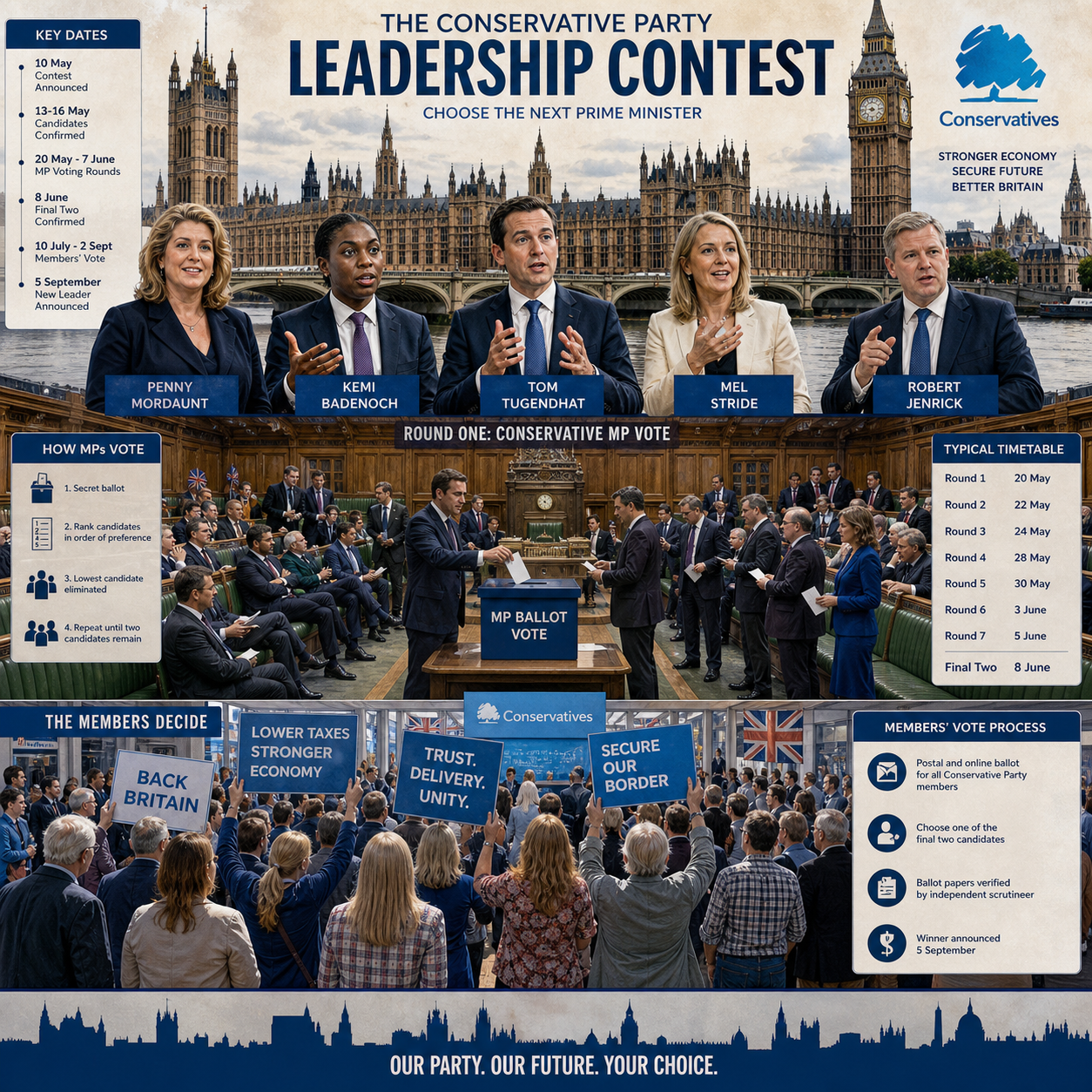
Leadership contests in the UK Conservative Party combine formal electoral rules with negotiation, endorsement building and political judgment. The process gives the Parliamentary Conservative Party a filtering role before Conservative Party membership makes the final choice, creating two linked but distinct tests for leadership candidates.
This case study examines how those tests have operated in selected contests. It focuses on the relationship between MPs’ ballots, the party membership ballot, policy and ideological factions, campaign positioning, and the wider circumstances surrounding prime ministerial succession.
How Conservative Party Leadership Contests Work
A Conservative leadership election normally proceeds through nominations, successive ballots among Conservative MPs, and a final vote by party members between the last two candidates. The precise leadership contest rules, timetable and eligibility requirements can change, so each election must be assessed in its own institutional context.
In the first stage, eligible candidates seek nominations from Conservative MPs. The party may set thresholds to limit the number of contenders and require candidates to demonstrate a minimum level of parliamentary support. When more than two candidates remain, MPs vote in successive rounds. The candidate with the fewest votes is generally eliminated, although the detailed rules can vary.
The MPs’ ballots perform two functions. They identify which candidates have enough support to remain viable, and they reveal the alliances operating inside the Parliamentary Conservative Party. Endorsements matter because MPs often assess electability, ministerial experience, ideological compatibility and the likelihood that a candidate can unite colleagues.
Once two finalists remain, Conservative Party membership usually votes by postal or secure electronic ballot. Members therefore receive a narrower choice than MPs initially considered. The final stage can reward a candidate’s ability to communicate with the grassroots, even where parliamentary support was evenly divided or where MPs preferred a different finalist.
For a useful institutional overview, researchers can consult the House of Commons Library briefing on Conservative leadership elections. It records how procedural arrangements have developed across different contests.
Selecting the Case Studies
The most useful case studies are contests that expose differences in rules, political context and candidate coalitions rather than simply providing a chronological list. This analysis therefore selects examples according to parliamentary competition, membership influence, and the circumstances of succession.
The first case is the 2005 contest, which demonstrates how MPs’ preferences and parliamentary alliances can shape the field before party members vote. The second is the 2019 contest, which shows the importance of membership positioning after a large parliamentary field has been reduced to two finalists. The third is the 2022 contest, which illustrates how government instability and rapid prime ministerial succession can disrupt the normal rhythm of a leadership election.
These cases are not intended to represent every Conservative leadership election. Instead, they provide contrasting observations across three dimensions:
- Institutional design: how nominations and MPs’ ballots structured the contest.
- Coalition building: how candidates combined parliamentary support with grassroots appeal.
- Political context: how opposition, government crisis or electoral pressure changed the meaning of leadership.
Case Study One: A Contest Shaped by Parliamentary Support
The 2005 Conservative leadership contest shows how parliamentary support can determine the final choice before Conservative Party members cast their ballots. David Cameron and David Davis reached the membership ballot after MPs eliminated other contenders, while Liam Fox withdrew after failing to secure sufficient parliamentary backing.
The contest followed the Conservative Party’s 2005 general election defeat and a period of debate about how the party should respond to Labour under Tony Blair. Candidates differed in emphasis. Davis represented a more established Eurosceptic and traditional Conservative position, while Cameron argued for a modernising approach designed to broaden the party’s appeal.
MPs’ ballots narrowed the field through a sequence of decisions about credibility and direction. Parliamentary colleagues did not merely select the candidate they personally preferred. They also considered which contender could present a plausible response to the electoral problem identified after the general election.
Endorsements and campaign momentum helped Cameron convert an initially uncertain position into a winning parliamentary coalition. Davis retained substantial support among MPs, but Cameron’s message offered a sharper contrast with the party’s recent image. Once the final two were established, the contest moved from parliamentary viability to a broader argument about political renewal.
The membership ballot then confirmed Cameron’s victory. The case demonstrates a central feature of the system: MPs control access to the final stage, but members can decide between two candidates whose profiles have already been shaped by parliamentary calculations.
Case Study Two: Membership Ballots and Campaign Positioning
The 2019 Conservative leadership election demonstrates how a finalist’s appeal to party members can depend on policy emphasis, communication style and perceived authenticity. Boris Johnson won after Conservative MPs reduced a crowded field to two candidates, with Jeremy Hunt as the other finalist.
The contest followed Theresa May’s resignation amid disagreement over Brexit and the government’s inability to secure parliamentary approval for her withdrawal agreement. Brexit was therefore both a policy issue and a test of leadership credibility. Candidates had to address Conservative MPs, many of whom prioritised parliamentary strategy, while also speaking to members who had strong views about the referendum’s unresolved outcome.
Johnson entered the contest with significant public visibility and a clear association with delivering Brexit. Hunt presented a different profile, stressing governing experience and a more cautious approach to the practical challenges facing the country. The contrast allowed the membership ballot to operate as a choice between leadership styles as well as between policy positions.
The MPs’ ballots were crucial in determining which messages reached the final vote. They reflected tactical considerations, including views about electoral prospects and the ability to command parliamentary support. Yet the membership ballot had its own political logic. Party members were not a miniature version of the parliamentary party; their priorities and measures of credibility could differ.
This contest illustrates the importance of what might be called the two-audience problem. A candidate must first appear viable to MPs, then sufficiently distinctive and trustworthy to members. A message that builds a parliamentary coalition may need to be sharpened or reframed for the grassroots stage.
Case Study Three: Crisis, Succession, or Electoral Pressure
The 2022 Conservative leadership contests show how political crisis can compress or alter the normal succession process. Boris Johnson’s resignation triggered a summer contest won by Liz Truss, while Truss’s subsequent resignation produced a rapid autumn contest in which Rishi Sunak became prime minister without a membership ballot.
The first 2022 election followed months of political instability, including the partygate controversy, ministerial resignations and pressure on Johnson’s government. Conservative MPs used successive ballots to reduce a large field, eventually sending Truss and Sunak to the membership. The campaign then focused heavily on economic strategy, taxation and the credibility of competing responses to inflation and fiscal pressure.
Truss won the membership ballot, but her premiership was soon damaged by the market reaction to the September 2022 mini-budget and by loss of parliamentary confidence. Her resignation created a second contest under markedly different conditions. The party faced urgency, financial-market scrutiny and the prospect of another period of instability.
In that setting, the formal route remained available, but political incentives changed. Rishi Sunak had already demonstrated substantial parliamentary support, while Penny Mordaunt also sought the leadership. The contest ended when Sunak became the only candidate to meet the applicable threshold after Johnson withdrew from consideration and Mordaunt did not secure enough nominations.
The two 2022 elections reveal that leadership contest rules operate within a wider environment. When time is abundant, members may receive a full campaign and ballot. During a crisis, MPs may prioritise speed, unity and market reassurance, reducing or eliminating the membership stage.
Comparing the Contests
Comparison across the three cases shows that Conservative leadership elections are shaped by a recurring interaction between rules, political context and candidate coalition building. The formal process provides structure, but informal judgments determine how candidates move through it.
| Contest | Primary pressure | Key dynamic | Outcome |
|---|---|---|---|
| 2005 | Post-election renewal | MPs narrowed the field around competing visions of modernisation | David Cameron won the membership ballot |
| 2019 | Brexit and government paralysis | Finalists competed for distinct grassroots and parliamentary coalitions | Boris Johnson won the membership ballot |
| 2022 | Government and economic crisis | Urgency increased the value of parliamentary consolidation | Liz Truss won the first contest; Rishi Sunak won the second without a membership ballot |
Several patterns stand out. First, MPs’ ballots are a gatekeeping mechanism. They affect not only who wins but which policy arguments reach the wider membership. Second, party members can reward a candidate whose message is more direct or ideologically resonant than the position preferred by some MPs.
Third, political circumstances change the value of different qualities. In opposition, renewal and electoral repositioning may dominate. During a Brexit dispute, policy clarity becomes central. In a government crisis, speed, competence and parliamentary stability can outweigh the benefits of a prolonged grassroots campaign.
Media narratives and endorsements also matter, although they should not be treated as independent causes in every case. They often reflect underlying parliamentary arithmetic, campaign organisation and perceptions of viability. A candidate who appears to be gaining momentum may attract further endorsements, creating a reinforcing cycle.
What Leadership Contests Reveal About the Conservative Party
Conservative leadership contests reveal a party whose internal democracy is deliberately divided between parliamentary judgment and membership choice. This arrangement can broaden participation while also creating tension between governing practicality, ideological identity and electoral strategy.
The cases suggest three wider conclusions. First, leadership legitimacy has two sources. A leader needs enough confidence from Conservative MPs to govern effectively, but also enough support from party members to claim an authentic mandate inside the organisation. Winning one audience does not guarantee durable authority with the other.
Second, contests expose party policy and ideological factions without always resolving them. A leadership election may settle who occupies the top office while leaving disagreements over taxation, Europe, social policy, public spending or electoral strategy unresolved. The contest is therefore a diagnostic event as much as a selection mechanism.
Third, the system is adaptable but that flexibility carries a trade-off. Changing thresholds or accelerating the timetable can prevent prolonged instability, yet it can also reduce the direct role of Conservative Party membership. Conversely, a full membership ballot may strengthen participatory legitimacy while extending uncertainty during a government crisis.
For political researchers, the most reliable interpretation combines three levels of evidence: the written rules, the sequence of MPs’ ballots, and the messages candidates used with members. Leadership contests are best understood as structured negotiations over party direction. Their outcomes reflect individual campaigning, but also the pressures facing the UK Conservative Party at the moment of prime ministerial succession.
Frequently Asked Questions
Who can stand in a Conservative Party leadership contest?
Eligibility depends on the rules adopted for that contest, but candidates generally need to be Conservative MPs and secure nominations from parliamentary colleagues. Thresholds can vary, so researchers should consult the official rules for the election being studied.
What role do Conservative MPs play in choosing the leader?
Conservative MPs nominate candidates and use successive ballots to reduce the field, normally selecting two finalists for the party membership ballot. In some circumstances, MPs can determine the leader directly if only one candidate remains.
How do Conservative Party members vote?
Eligible Conservative Party members normally vote between the final two candidates through a party-administered ballot. The voting method and eligibility date may change between elections.
Why do leadership contests produce different outcomes?
Outcomes vary because candidates face different political contexts, parliamentary coalitions and membership preferences. The same campaign tactic may work in opposition but prove less persuasive during a government or economic crisis.
Can Conservative leadership election rules change?
Yes. The Conservative Party can revise nomination thresholds, ballot arrangements and the role of members. Those changes are politically significant because they alter the balance between the Parliamentary Conservative Party and the wider membership.